Saturday, 12 May 2012

Design Development on female form

Full outfit design development drawings on a women's form. I thought it would be better to get my ideas out of a shape that I am used to designing with however for all these garments I had the male form in mind and was thinking how they could wear the clothes in a different way. 

I like the cross over jackets (first and third). I think they would be very versatile in both mens and women's fashion as you could do the crossover tighter/leave it open (as a relaxed blazer) depending how you wanted it. This style would suit a wider segmentation of the market (from teenagers/ university students etc right through to busy parents for a more casual dress). I also like the second to last outfit however I think that the cropped jacket would not be wearable for a man. The last slouch pants in green, I believe would be very popular for a younger market as they are on trend and a comfortable basic. The trousers with the ties at the ankle are intended to be only worn by the woman as I believe the straight down leg (that would suit a man's figure) would not suit the woman's figure as well. I think this is partially guided by a trend toward tight fitting jeans etc so to have a straight leg seems abnormal. 


For the first outfit, I tried to take that cropped jacket and make it more masculine - I think I did the opposite as the flap down the back makes the whole outfit more feminine, (I am unsure, in two minds..). The color choices have deviated slightly from the Margareta collection for two main reasons - firstly I wanted the colors to be slightly more up beat at therefore more wearable and secondly I needed them to be unisex. I imagine more of a khaki green instead of this quite vibrant one. I will also consider adding slices of black into the outfits as this is unisex and very trans seasonal. 


Design Development Sketches

These are some quick sketches I did - just getting out some key ideas of layers and 'protective' wear.


Maison Martin Margiela


Maison Martin Margiela is a huge inspiration in all my work. I have rented several books from the library and constantly have them on return and literally lug them round with me just for the sake of having that inspiration with me. I love how the house addresses the ideas of ‘the body’ (whatever shape it may be) and somewhat protects it with distressed tailoring. The House’s philosophy is precisely informed by a procedure that refuses to be governed by the compulsive view that fashion should reinvent itself entirely every single season. Two aspects really interest me about the house’s work:

-     1.  The concept of time and its view on the human body. The concept of time is interpreted in various ways: as the duration that is expressed through the use of certain fabrics and the objects relating to the passage of time and the process of ageing; time in the view of the history of fashion and finally time as referring to the history of the garment itself which is made visible through the externalization of the production process = the sewing of darts on outside of garments/ revealing seams etc. How does this relate to my collection? I want to use Hemp fabrics,100% Linens and organic cotton etc that literally break down over time hence have a history – life. I want my collection to be able to be worn in multiple ways by both men and women therefore the clothes make their own history through how the wearer chooses to wear them and how they fit the individual body shape. Lastly, the process of zero waste pattern making could be effectively externalized in the garments with folds on the outside of seams etc – this works (to me) as by wearing zero waste you are literally presenting a change in attitude in our consumer driven society hence this should be exclaimed and presented to outsiders. I also like the idea that the garments – through the fabrics/production literally show the idea of ageing and decay which draws from my inspiration from the Margareta collection of the Grey Gardens documentary.
-     
      2.  Maison Martin Margiela changes, significantly, the standardized body as prescribed by fashion. (By this I do not mean going against stick thin models etc – rather diving into the idea of male and female shapes). Various collections exploited the idea of oversized clothing, wrapping the body like “gigantic artificial cocoons.” The spring summer collection (2000) featured garments in two different sizes: “A stereotype made up in white cotton to emphasize the basic characteristics of form and to introduce an aspect of abstraction, and an enlarged version of that stereotype made up in a selection of the most typical fabrics for a garment of this type. The enlargements included secondhand dresses, tops and slips whose form and original size have been transformed by hand rendering, a uniform size 74 for all garments.”

These ideas relate so closely to my thinking. The idea of the body in a cocoon and questioning ideas of size in the fashion world (not dress size but sizes of clothing in general and why this is different from a woman to a man. This brings me to the idea of silhouette that Maison Martin Margiela is so famous for challenging – again looked through via the concept of the body. The 1997 collection experimented with the double production process 

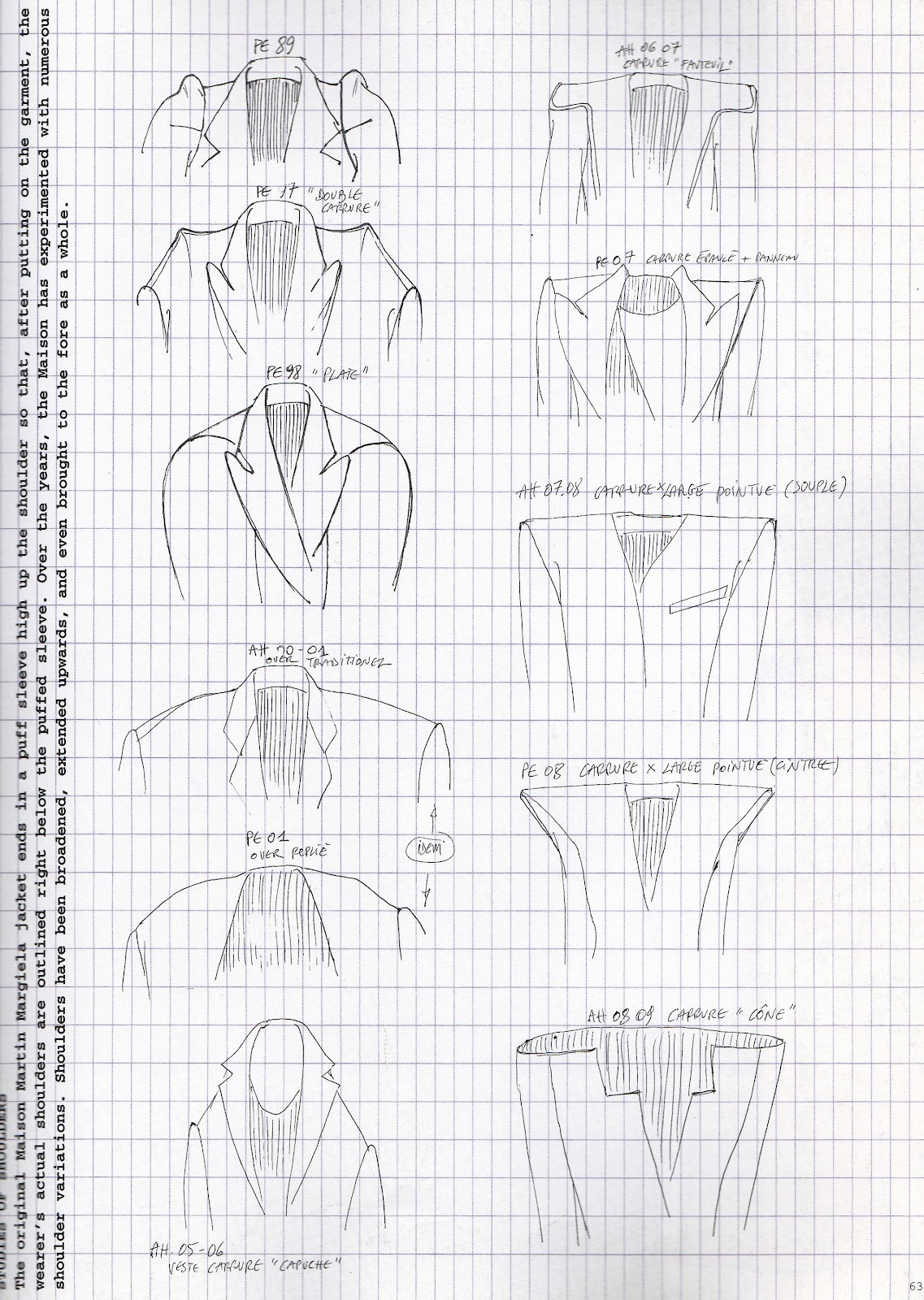
“Jackets are cut to a man’s proportions. Once finished, the internal structure is removed and a second feminine shoulder line is added through the use of shoulder pads over which the original man’s shoulder line hangs.”


 I am having a lot of trouble getting the shoulder line to fit both the men’s and women’s form in the jacket I have draped – this idea could solve my issues! To apply a type of accessory that a women could buy with there unisex garment that covers the original man’s shoulder line. Although the house has not talked about a unisex collection, these ideas that cross over from men’s forms to women’s forms are a substantial starting ground for reshaping the silhouettes of men’s and women’s fashion and in doing so re reading the fashion system that grounds this silhouette!


The photograph above shows a classic trench with the collar enlarged – this present the idea of being protected/hidden. It is made by incorporating two vintage coats (fabrics have a history). I like how the garments still have a deffinate structure and the deconstruction process has not hindered this, they still look new and modern. Also note the tabi boots in this image that are probably the most iconic accessory of the house. They are inspired by Japanese tabi.


Flat garments like the ones above and below also caught my eye as you need zero waste garments to be somewhat flat and geometric to be made into patterns. This image is from the 1998 collection that is a series of flat garments whose structure has been adapted so that when they are not worn, they fall totally flat. Assembling panels of industrial garment patterning create foldable pieces. The collection also includes garments that have full-length zippers along the sides, which allow them to be opened completely and laid flat.


The photograph above shows the displacement of the shoulder line towards the front and flattened through a special ‘crushing’ process. I like the aesthetic that this creates.
In conclusion, Maison Martin Margiela is a house, which I completely admire and am inspired to. I believe, concepts of time and the view on the human body could really cohesively work into my project. 


Friday, 11 May 2012

Shirt toile


These are some photographs/drawings of a unisex shirt I draped. I am applying Maison Martin Margiela's technique of covering the armhole line (of a men's shirt) with a shoulder pad (seen in the drawing). 

Tuesday, 8 May 2012

Is recycled polyester fabric RECYCLABLE?

I found this blog on recyclable fabrics and what it is doing to the environment. It seems that a lot of the time although recycling has good methods in mind, it ends up defeating the purpose and doing more bad than good in the long run.


A fabric made of “recycled material” has a certain percentage of polyester which comes from these chips that the recycling facility has manufactured.  Using these chips has several issues which are exclusive to the textile industry:
  • The base color of the recycled polyester chips vary from white to creamy yellow, making color consistency difficult to achieve, particularly for the pale shades.  Some dyers find it hard to get a white, so they’re using chlorine-based bleaches to whiten the base.
  • Inconsistency of dye uptake makes it difficult to get good batch-to-batch color consistency and this can lead to high levels of re-dyeing, another very high energy process.  Re-dyeing contributes to high levels of water, energy and chemical use.
  • Unsubstantiated reports claim that some recycled yarns take almost 30% more dye to achieve the same depth of shade as equivalent virgin polyesters.[1]
  • Another consideration is the introduction of PVC into the polymer from bottle labels and wrappers.
  • Many yarns made from recycled polyester are used in forgiving constructions such as polar fleece, where the construction of the fabric hides slight yarn variations.  For fabrics such as satins, there are concerns over streaks and stripes.
Most of the plastics in use today can be recycled but, because mechanical recycling produces a less stable polymer, the products which can be made from this recycled plastic are of “less value” than the original.  The products made from the “chips” must be a bit forgiving, such as carpet, plastic lumber, roadside curbs, truck cargo liners, waste receptacles (you get the idea).  William McDonough calls this “downcycling”.  No matter how many smiling people you see throwing their bottles into a recycling container and “preventing the plastic from entering our waste stream” as the media likes to put it – the reality is that the recycling can only be done mechanically a few times before the polymers break down and the plastic is no longer useful or useable – every time plastic is melted down, its molecular composition changes, its quality degrades, and the range of its usefulness shrinks.   So after going from a virgin PET bottle, to carpet fibers, to plastic lumber, to a speed bump – that’s when it enters our waste stream.  So recycling plastic doesn’t prevent this occurrence – it just postpones it.  Read more about “the seduction of plastic” .
To add insult to injury, if you had bought the fabric mentioned above and hoped the fabric would be recyclable as claimed:  probably not gonna happen, because remember how the recycling facility had to separate bottles to make sure each resin was melted with similar types?  Think of the fabric as similar to bottles with different plastic resins:  many fabrics are woven of different types of plastic (60% polyester, 40% nylon for example), or there is a chemical backing of some sort on the fabric.  These different chemicals, with different molecular weights, renders the fabric non-recyclable.  Period.
And even if the fabric we’re talking about is 100% polyester with NO chemical backings or finishes, there is a problem with recycling in the system itself.  Although bottles, tins and newspapers are now routinely collected for recycling, furniture and carpets still usually end up in landfill or incinerators, even if they have been designed to be recycled because the fabric must be separated from other components if it’s part of an upholstered piece of furniture, for example.
Chemical recycling is the alternative technology and it does exist.  During chemical recycling, the materials are chemically dissolved into their precursor chemicals.  Polyester, for example, would be broken down into DMT (dimethyl terephthalate) and EG (ethylene glycol).  These chemicals are then purified and used to make new polyester fiber.  But the reality is that this is difficult and expensive to do.  Patagonia has made using recycled plastics a priority and gives a good overview of the process with interesting comments about the unique problems they’re encountering; read about it here.
Currently, fabrics identified as being “recyclable” really are not  - because the technology to recycle the fibers is either too expensive (chemical) or doesn’t exist (mechanical) and the infrastructure to collect the fabric is not in place.    Few manufacturers, such as Designtex (with their line of EL fabrics designed to be used without backings) and Victor Innovatex (who has pioneered EcoIntelligent™ polyester made without antimony),  have taken the time, effort and money needed to accelerate the adoption of sustainable practices in the industry so we can one day have synthetic fabrics that are not only recycled, but recyclable.
So when you buy a fabric made of recycled polyester, remember it’s at the end of its useful life as a plastic  – and you are contributing to our dependence on non renewable resources and to the overwhelming burden of non-degradeable plastic in our environment.

Jordan, C. (Ed.). (2011, november 11). Is recycled polyester fabric RECYCLABLE? Retrieved may 8, 2012, from O ecotextiles : http://oecotextiles.wordpress.com/2009/11/11/is-recycled-polyester-fabric-recyclable/

This article pretty much looks at how reusing plastic is just prolonging when it is going to be unusable. Does this defeat the purpose? I believe it is better to REDUCE before thinking about RECYCLING 

Monday, 7 May 2012

Why I want to use Linen?

I really like Linen. I think it is long lasting, unisex sex and promotes a sustainable life style. It is a good in between fabric as sometimes you can not source organic fabrics especially a small business starting out. These are some reasons why I should use linen..


Linen is a textile made from the fibers of the flax plant, Linum usitatissimum. Linen is valued for its exceptional qualities.


Linen fabrics have been serving humans since approximately ten thousand years ago. It were ancient Egyptians who first started to use linen for clothes and bedding. We know that from rock carvings. Local riches were clad in thin linen fabrics; linen fabrics were used for wrapping of pharaoh mummies. Linen clothes were used as a symbol of “purity and light”. They were considered to be pure and at the same time serve as a guardian for the body of the person who was wearing it.
Peasants used home-made linen clothes.
In ancient Greece linen clothes were a privilege of priests.
 
At later times linen was grown and processed in other, northern, countries.
There it was called  “north gold” and “north silk”. It was used for clothes, table and bed linens, military equipment, canvas for oil pictures.
In previous centuries linen was considered to be a “healthy fabric”.

Despite all those thousands or years behind its back, linen, the most ancient fabric, remains forever young.
Linen popularity is not diminishing, it is growing with each year.
The secret of its popularity lies in the unique and highly valuable qualities of linen fabric.

- It is considered to be able to regulate body temperature by regulating skin-air heat exchange.
Linen absorbs moister well and at the same time releases it quickly, dries out, so linen fabric doesn’t "stick" to the body. Air can pass through linen fabric easily, so the skin is "breathing".

- Linen creates a feeling of freshness in hot weather and comfort warmth in winter. It is due to high thermo insulation qualities of the linen. When the weather is hot, the temperature between the body and linen is 3-4 degree below the air. When it is cold, the linen fabric carefully saves the body’s heat.

- Linen possesses high air permeability and heat conductivity properties. Heat conductivity of linen is five times as high as that of wool and 19 times as that of silk. In hot weather those dressed in linen clothes are found to show the skin temperature 3°-4°C below that of their silk or cotton-wearing friends. According to some studies, a person wearing linen clothes perspires 1.5 times less than when dressed in cotton clothes and twice less than when dressed in viscose clothes. Meanwhile in cold weather linen is an ideal warmth-keeper;

- It  doesn’t cause allergic reactions.
- Linen fabric don’t create static (in fact, even having small amount of linen in the fabric, up to 10%, removes possibility of static on the fabric).

- Linen fabric possesses rare bacteriological properties. Linen fabric is a natural antiseptic, it kills bacteria, so neither bacteria nor fungus can live on it. It also reduces inflammation. These qualities were noted by people long time ago when it was noted that wounds under linen dressing healed faster than under the cotton ones. Wearing linen clothes helps to get rid of some skin diseases - from common rash to chronic eczema.

- Linen reduces gamma radiation nearly by half and protects the human body from solar radiation. Flax fiber from contaminated soils appears not to exhibit even traces of radiation.

- Linen rejects dirt and does not get teaseled.

- Linen and linen-containing articles are easily laundered in hot water, can be boiled and dried in the sun. Hot water kills bacteria and dust mites. Besides they can be hot-ironed thereby ensuring maximum sterilization.

- The more linen is washed the softer and smoother it becomes.

- Linen is renowned for its spectacular durability and long life. The tensile strength of linen thread is twice as high as that of cotton which means that linen can withstand more washing cycles and serve for much longer time than cotton bedding.

- Linen underscores naturalness, softness and relief; creasing is yet another precious property possessed by linen.

- Linen has rich texture and feels pleasant to the touch (we love sewing linen fabric!).

So, to sum it up: linen bedding provides exceptional sleeping environment, is healthy, eco-friendly, easily washed, beautiful and long-lasting .

All these unique features of linen fabrics were always highly valued by people, and now, overwhelmed with and overexposed to synthetics, we are coming back to this natural fabric.

Linen clothes and linen bedding have become fashionable again and make their way back to our life.
Nothing can compare with pleasant to touch, textured, cool and fresh linen sheets in summer or in winter. Linen bedding just help relax and have a tight, refreshing, healthy sleep.

Linen fabric cost is relatively high now, so it has become elite material and is used mostly by mid- and high-class people. (info@linenlinens.com, 2009)

info@linenlinens.com. (2009, Sept 1). Linen Linens. Retrieved May 31, 2012, from Linen Linens : http://www.linenlinens.com/why_linen.html


Sunday, 6 May 2012

Organic Cotton

I thought I should look at some organic materials to get a better idea of which ones to use for my collection. This is some research I did on organic cotton.


Organic definitions

Organic refers to the way agricultural products are grown and processed.  It includes a system of production, processing, distribution and sales that assures consumers that the products maintain the organic integrity that begins on the farm.

Setting the stage for U.S. National organic standards, the U.S. Congress adopted the Organic Foods Production Act (OFPA) in 1990 as part of the 1990 Farm Bill. This action was followed by over a decade of public input and discussion, which resulted in a National Organic Program final rule published by the U.S. Department of Agriculture (USDA) in December 2000 and implemented in October 2002.

These stringent standards put in place a system to certify that specific practices are used to produce and process organic agricultural ingredients used for food and non-food purposes.

National organic standards set out the methods, practices and substances used in producing and handling crops, livestock and processed agricultural products. The standards include a national list of approved synthetic and prohibited non-synthetic substances for organic production.((OTA), 2011)

(OTA), T. O. (2011, Feb 16). Oraganic trade association . Retrieved May 31, 2012, from Organic trade association : http://www.ota.com/definition/quickoverview.html

WHERE IS THIS USED IN THE MARKET PLACE? - KOWTOW

SUSTAINABILITY

Fairtrade

“The World Health Organisation estimates that 20,000 people a year die in developing countries from pesticide poisoning, and a further 3 million people suffer chronic health problems”
Kowtow only uses 100% fairtrade certified cotton, as certified by the Fairtrade labelling Organisation and the benefits are:
  • The Fairtrade guaranteed minimum price covers the costs of production and provides a sustainable livelihood for Kowtow cotton producers.
  • The Fairtrade premium enables co-operatives to fund projects that benefit the organisation and wider community: business and agricultural training; drilling bore holes for clean water; building schools and clinics.
  • Kowtow fairtrade producers benefit from advance payment and long-term relationships with buyers.
  • Kowtow fairtrade producer groups are democratically run and respect the rights of farmers and farm workers.
  • Fairtrade production standards encourage sustainable agriculture and protection of the environment.

Organic

“Cotton covers 2.5% of the world’s cultivated land, yet it accounts for 25% of the world’s insecticide market and 10% of global pesticide sales, making it the most pesticide-intensive crop grown on the planet”
Kowtow only uses 100% organic certified cotton, as certified by SKAL International and the benefit are:
  • Never uses genetically modified seeds.
  • Conserves soil though crop rotation.
  • Retains water more efficiently thanks to increased organic matter in the soil.
  • Controls weeds through physical removal rather than chemical destruction.
  • Controls insects by maintaining a balance between “pests” and their natural predators through healthy soils.

Manufacturing

The factory in Kolkata, India where Kowtow garments are made has the following benefits:
  • Only works with certified organic cotton.
  • Factory sponsors projects such as Girls Education, Cow Shed and Cow Donation programs in the farmers villages. 
  • All fabric is dyed using Global Organic Textiles Standard (GOTS) approved dyes which are free of hazardous elements such as nickel, lead, formaldehyde, amines, pesticides and heavy metals.
  • Employees receive a living wage and factory pays for their social security and pension funds.
  • Employees receive House Rent, which is 5% of their basic wages. 
  • Employees receive free transport services to the factory.
  • Employees receive paid holiday leave, sick pay, medical insurance, subsidies lunches and overtime pay.
  • Employees children all receive free schooling.
  • Employees work in a well lit, well ventilated and spacious working environment.
  • Benefit from work place unions.


Elliott, G. (2010, june 4). KowTow Organic About . Retrieved may 1, 2012, from Kow Tow : http://www.kowtowclothing.com/pages/sustainability

Kow Tow does a fantastic job of maintaining sustainability methods within and outside their company.