Sunday, 13 May 2012

Jackets and Outerwear

These are a few jackets/outerwear that I designed. I found a khaki pen so have been using that instead of the green. Unsure what I think but I do know that the khaki is much more unsex and is definitely more cohesive with my collection ideas. I think the color also appeals to a larger market where as the previous vibrant green was more for someone who had that kind of loud personality and really wanted to wear something a bit different. 


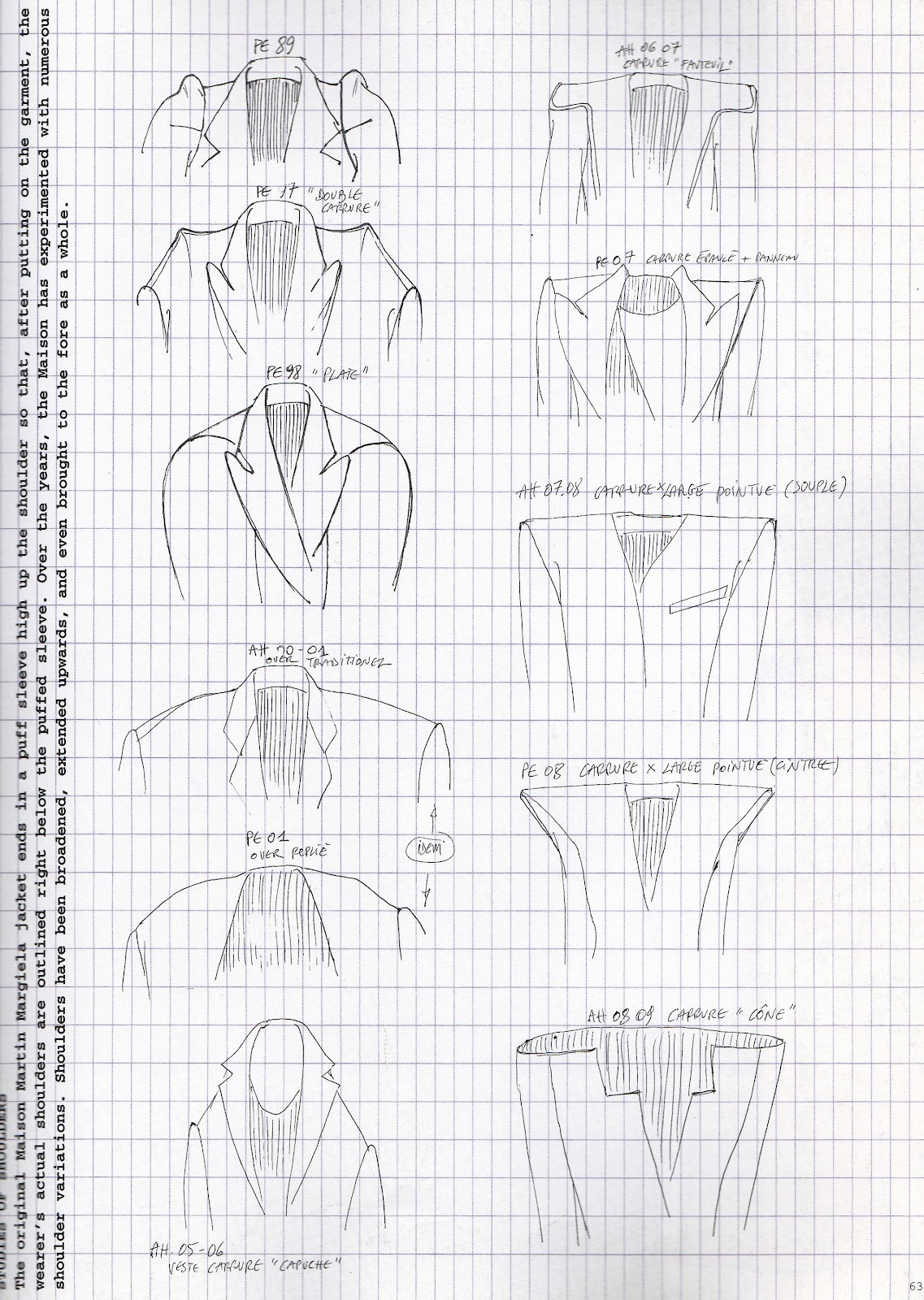
The first jacket is similar to the one I have been draping throughout this assignment. I really like were it is going... I can imagine this is a thick lined linen to be more solid and also a soft organic cotton. The second design has quite a thick cowl. This would be a good time to use Maison Martin Margiela's technique of covering the armhole line with a shoulder pad as this makes it more wearable. 


I have started doing different color variations for men's and women's more for the point of seeing what different color combinations look like. I like the idea of layering vests under jackets for guys as I have done with the first design (quilted vest under loose baseball style jacket). With the second design I choose a much more tailored fit but to be totally honest I think this would be quite impossible to fit the man and the woman with that close fit. 


Experimenting with capes and fold over capes here. I like the idea of shoulder pads and elbow pads as they add a really discreet detail (and is good for zero waste when you don't no what to do with a little square!). It also brings the collection back to its 'protective' roots. 

Trouser - Unisex

For these design I was solely focussing on trousers. I believe trousers/pants are a great staple piece and having unusual trousers usually lasts through the seasons. After talking to my flatmates, who are at the lower age end of my target market they said they wished there were more interesting pants out there that go beyond the printed boat pants or skinny legs. I think this unisex collection definitely address that. I have tried to include all different types of pants from drop crotch to tailored. 

These first pants are one of my favorite. They would be done in an organic super soft charcoal cotton and as illustrated here, both men and women would wear them in different ways. The woman would most likely wear hers high waisted. 

Again playing with the idea of the tie around the leg which would be a separate feature that the shop would offer. They make a tailored straight leg quite unusual. These pants would have tuxedo straps on the waist to make them fitted for a smaller woman. 

I like this idea of using pattern but need to use photoshop possibly to mix this in as right now it looks to flat and rigid. I like the idea of having a side panel of a different color but I believe that the green is to vibrant next to that grey. 

Using the idea of the two panels again in these variations. In the design on the right, machine quilting would shape the side of the pants which comes back to the idea of 'protecting'. 

A little bit of Issey


Issey Miyake's basic view for making clothes has always been the idea of creating a garment from 'one piece of cloth', and the exploration of the space between the human body and the cloth that covers it. He has always been a designer who I have admired and his ideas around making clothes are coherent with zero waste fashion. Particularly the designs pictured above represent styles that could be effectively weaved into my collection in a wearable/ready to wear way. 

Slowing Fashion - Gene Sherman and Issey Miyake


The photograph above is an image of Dr Gene Shermans notebook which records all the amazing pieces that she formally collects. For Gene the mantra, ‘buy less, buy better’ is evident in her 25 piece wardrobe which includes the pieces of mostly Japanese designers including Yohji Yamamoto, Issey Miyake and Rei Kawakubo.

The work of these Japanese designers can be described as timeless, original in design and often unusual, which allows the pieces to easily transcend a six-month fashion season. Gene purchases garment during her two annual trip to Tokyo and when she gains a new piece she retires another which she documents carefully and donates/has donated to power house fashion museum. For Gene, this slower pattern of consumption enables her to create a deeper level of engagement with the clothes themselves and to build over time a personal ongoing narrative and set of associative values. I want my collection to correspond with this kind of value and ongoing history. 


Saturday, 12 May 2012

Design Development on female form

Full outfit design development drawings on a women's form. I thought it would be better to get my ideas out of a shape that I am used to designing with however for all these garments I had the male form in mind and was thinking how they could wear the clothes in a different way. 

I like the cross over jackets (first and third). I think they would be very versatile in both mens and women's fashion as you could do the crossover tighter/leave it open (as a relaxed blazer) depending how you wanted it. This style would suit a wider segmentation of the market (from teenagers/ university students etc right through to busy parents for a more casual dress). I also like the second to last outfit however I think that the cropped jacket would not be wearable for a man. The last slouch pants in green, I believe would be very popular for a younger market as they are on trend and a comfortable basic. The trousers with the ties at the ankle are intended to be only worn by the woman as I believe the straight down leg (that would suit a man's figure) would not suit the woman's figure as well. I think this is partially guided by a trend toward tight fitting jeans etc so to have a straight leg seems abnormal. 


For the first outfit, I tried to take that cropped jacket and make it more masculine - I think I did the opposite as the flap down the back makes the whole outfit more feminine, (I am unsure, in two minds..). The color choices have deviated slightly from the Margareta collection for two main reasons - firstly I wanted the colors to be slightly more up beat at therefore more wearable and secondly I needed them to be unisex. I imagine more of a khaki green instead of this quite vibrant one. I will also consider adding slices of black into the outfits as this is unisex and very trans seasonal. 


Design Development Sketches

These are some quick sketches I did - just getting out some key ideas of layers and 'protective' wear.


Maison Martin Margiela


Maison Martin Margiela is a huge inspiration in all my work. I have rented several books from the library and constantly have them on return and literally lug them round with me just for the sake of having that inspiration with me. I love how the house addresses the ideas of ‘the body’ (whatever shape it may be) and somewhat protects it with distressed tailoring. The House’s philosophy is precisely informed by a procedure that refuses to be governed by the compulsive view that fashion should reinvent itself entirely every single season. Two aspects really interest me about the house’s work:

-     1.  The concept of time and its view on the human body. The concept of time is interpreted in various ways: as the duration that is expressed through the use of certain fabrics and the objects relating to the passage of time and the process of ageing; time in the view of the history of fashion and finally time as referring to the history of the garment itself which is made visible through the externalization of the production process = the sewing of darts on outside of garments/ revealing seams etc. How does this relate to my collection? I want to use Hemp fabrics,100% Linens and organic cotton etc that literally break down over time hence have a history – life. I want my collection to be able to be worn in multiple ways by both men and women therefore the clothes make their own history through how the wearer chooses to wear them and how they fit the individual body shape. Lastly, the process of zero waste pattern making could be effectively externalized in the garments with folds on the outside of seams etc – this works (to me) as by wearing zero waste you are literally presenting a change in attitude in our consumer driven society hence this should be exclaimed and presented to outsiders. I also like the idea that the garments – through the fabrics/production literally show the idea of ageing and decay which draws from my inspiration from the Margareta collection of the Grey Gardens documentary.
-     
      2.  Maison Martin Margiela changes, significantly, the standardized body as prescribed by fashion. (By this I do not mean going against stick thin models etc – rather diving into the idea of male and female shapes). Various collections exploited the idea of oversized clothing, wrapping the body like “gigantic artificial cocoons.” The spring summer collection (2000) featured garments in two different sizes: “A stereotype made up in white cotton to emphasize the basic characteristics of form and to introduce an aspect of abstraction, and an enlarged version of that stereotype made up in a selection of the most typical fabrics for a garment of this type. The enlargements included secondhand dresses, tops and slips whose form and original size have been transformed by hand rendering, a uniform size 74 for all garments.”

These ideas relate so closely to my thinking. The idea of the body in a cocoon and questioning ideas of size in the fashion world (not dress size but sizes of clothing in general and why this is different from a woman to a man. This brings me to the idea of silhouette that Maison Martin Margiela is so famous for challenging – again looked through via the concept of the body. The 1997 collection experimented with the double production process 

“Jackets are cut to a man’s proportions. Once finished, the internal structure is removed and a second feminine shoulder line is added through the use of shoulder pads over which the original man’s shoulder line hangs.”


 I am having a lot of trouble getting the shoulder line to fit both the men’s and women’s form in the jacket I have draped – this idea could solve my issues! To apply a type of accessory that a women could buy with there unisex garment that covers the original man’s shoulder line. Although the house has not talked about a unisex collection, these ideas that cross over from men’s forms to women’s forms are a substantial starting ground for reshaping the silhouettes of men’s and women’s fashion and in doing so re reading the fashion system that grounds this silhouette!
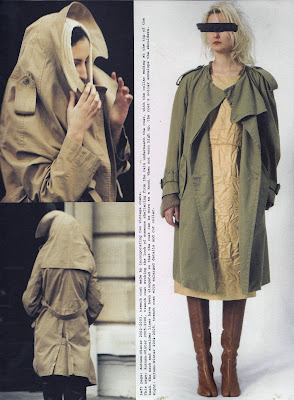

The photograph above shows a classic trench with the collar enlarged – this present the idea of being protected/hidden. It is made by incorporating two vintage coats (fabrics have a history). I like how the garments still have a deffinate structure and the deconstruction process has not hindered this, they still look new and modern. Also note the tabi boots in this image that are probably the most iconic accessory of the house. They are inspired by Japanese tabi.


Flat garments like the ones above and below also caught my eye as you need zero waste garments to be somewhat flat and geometric to be made into patterns. This image is from the 1998 collection that is a series of flat garments whose structure has been adapted so that when they are not worn, they fall totally flat. Assembling panels of industrial garment patterning create foldable pieces. The collection also includes garments that have full-length zippers along the sides, which allow them to be opened completely and laid flat.


The photograph above shows the displacement of the shoulder line towards the front and flattened through a special ‘crushing’ process. I like the aesthetic that this creates.
In conclusion, Maison Martin Margiela is a house, which I completely admire and am inspired to. I believe, concepts of time and the view on the human body could really cohesively work into my project.